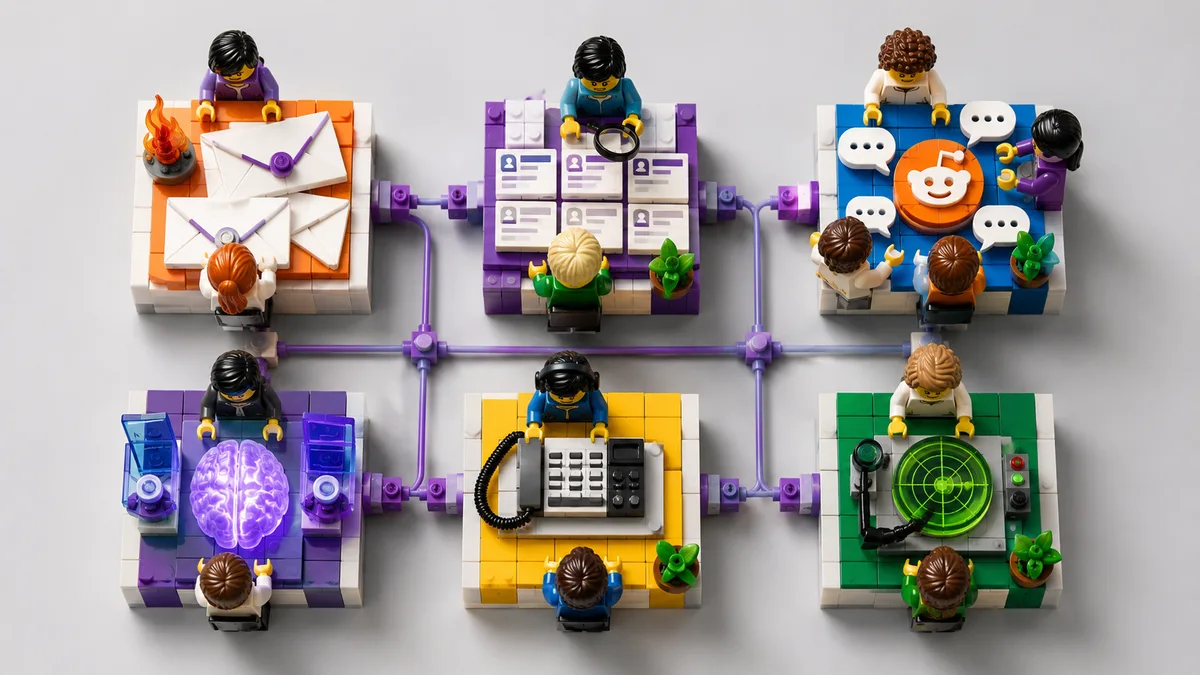
For the past decade, social listening has followed the same pattern: set up keywords, receive alerts, read mentions, and react. The human is in the loop at every step. That is about to change fundamentally. AI agents, software programs that can perceive, reason, and take action on their own, are starting to plug directly into social listening tools. And the technology making this possible is the Model Context Protocol (MCP), an open standard that lets AI assistants like Claude and ChatGPT connect to external data sources and take actions. We built a social listening MCP server for Buska, and what we have seen in early usage is a preview of how this entire category is going to evolve. This guide covers what AI agents mean for social listening, how MCP works, real use cases happening today, and where this is headed.
What are AI agents in social listening?
An AI agent is a software program that can observe its environment, make decisions, and take action without waiting for human instructions at every step. In the context of social listening, an AI agent can monitor brand mentions, analyze sentiment, identify buying signals, and even draft responses or trigger workflows, all autonomously.
This is different from AI-powered features, which most social listening tools already have. AI-powered features use machine learning for tasks like sentiment classification or lead scoring, but a human still decides what to do with the output. An AI agent goes further: it reads the mention, assesses its importance, decides on the appropriate action, and executes it. The human sets the rules and reviews the results, but the agent handles the middle steps.
Think of the difference this way. Today's social listening is like having a very smart assistant who reads all your mail and highlights what matters. An AI agent is like having that assistant read the mail, draft replies, schedule meetings, and file follow-ups, then show you a summary of what was done. The shift is from "detect and alert" to "detect and act."
What is MCP (Model Context Protocol)?
The Model Context Protocol, or MCP, is an open standard created by Anthropic that defines how AI models connect to external tools, data sources, and services. Think of it like USB for AI. Before USB, every device needed its own proprietary cable. Before MCP, every AI integration needed custom code. MCP provides a standard interface that any AI client (Claude Desktop, ChatGPT, Cursor, etc.) can use to connect to any compatible server.
An MCP server exposes capabilities to AI models: reading data, executing searches, triggering actions. The AI model acts as the MCP client. When a user asks Claude "show me all brand mentions from this week with high buying intent," Claude connects to the social listening MCP server, retrieves the data, and presents it in a natural conversation. No dashboards. No manual exports. Just a question and an answer.
What makes MCP different from a regular API? Two things. First, it is designed for AI consumption, not human consumption. The data format and interaction patterns are optimized for how AI models process information. Second, it supports bidirectional communication. The AI model can not only read data from the server but also trigger actions, creating a foundation for truly autonomous workflows.
Buska's MCP server: how it works
Buska's MCP server is available as an npm package called buska-mcp-server. You install it, connect it to your Buska account via API key, and then any MCP-compatible AI client can access your social listening data. The server exposes your mentions, keywords, lead scores, and analytics through the MCP protocol. If you would rather not write prompts from scratch, the agent skills for Buska package ready-made lead-gen workflows for Claude, ChatGPT, and Cursor.
The setup takes about five minutes. Install the package, add your API key to the configuration file, and point your AI client to the local MCP server. Once connected, you can have conversations like these with Claude Desktop or any MCP-compatible assistant:
- "Show me all mentions from this week where someone is looking for an alternative to [competitor]."
- "Which Reddit threads from the past 30 days have the highest buying intent score?"
- "Summarize the sentiment trends for our brand mentions on Twitter this month."
- "Find all mentions where someone is asking for product recommendations in our category."
- "Compare our mention volume to [competitor] across all platforms for the last quarter."
Each of these would normally require logging into a dashboard, setting filters, exporting data, and analyzing it manually. With MCP, the AI handles all of that and returns a natural-language summary. For a complete walkthrough of setting up social listening from scratch, see our social listening setup checklist.
# Install Buska MCP server
npm install -g buska-mcp-server

# Add to Claude Desktop config (~/.claude/mcp_servers.json)
{
  "buska": {
    "command": "buska-mcp-server",
    "env": {
      "BUSKA_API_KEY": "your-api-key-here"
    }
  }
}
5 real use cases for AI agents in social listening
AI agents connected to social listening data open up workflows that were not practical before. Here are five that are already happening with early adopters.
1Autonomous buying signal detection and qualification
Instead of receiving an alert for every mention and manually deciding which ones are worth pursuing, an AI agent reads each mention, cross-references it with your ICP criteria, checks the author's profile and company data, and classifies the lead as hot, warm, or cold. You only see the ones that are qualified and ready for outreach. This transforms how teams act on intent signals, turning a firehose of mentions into a prioritized pipeline.
2Competitive intelligence briefings
Ask your AI agent "give me a weekly competitive intelligence briefing" and it pulls all competitor mentions from the past week, analyzes sentiment trends, identifies new product launches or feature announcements, flags negative sentiment spikes, and compiles everything into a structured report. What used to take an analyst half a day happens in seconds.
3Automated response drafting
When someone posts on Reddit asking for tool recommendations in your category, an AI agent can detect the mention, analyze the context, draft a helpful response that positions your product naturally, and queue it for human review before posting. The agent does 90% of the work. The human approves or edits the final message. Response time drops from hours to minutes.
4Crisis detection and escalation
An AI agent monitors mention volume and sentiment in real time. When it detects a sudden spike in negative mentions, or a high-profile account posting criticism, it can automatically classify the severity, pull together the relevant mentions, draft a situation summary, and alert the right team members. This goes beyond simple threshold alerts. The agent understands context and can distinguish between a genuine crisis and normal noise. For the foundation of this approach, see our guide on detecting brand crises early.
5Cross-platform analytics and reporting
Ask the agent to "compare our Reddit mention trends with Twitter trends for the past quarter and identify any platform-specific patterns." The agent pulls data from both platforms through Buska's MCP server, runs the analysis, and returns insights. No manual data pulls. No spreadsheets. No pivot tables. Just a question and a data-driven answer.
From alert-and-react to detect-and-act
The bigger picture here is a fundamental shift in how social listening works as a discipline. Today's workflow is reactive: a mention happens, an alert fires, a human reviews it, a human takes action. Tomorrow's workflow is proactive: an agent continuously monitors, qualifies, and acts, with humans setting strategy and reviewing results.
This shift does not eliminate the need for human judgment. It eliminates the repetitive work that prevents humans from exercising that judgment on the things that actually matter. Instead of spending an hour every morning sorting through 50 mentions to find the 3 that need attention, you spend 10 minutes reviewing the 3 actions your agent has already prepared.
For teams using tools like n8n with Buska, AI agents add an intelligence layer on top of existing automation. N8n handles the mechanical workflows (route this mention to Slack, add this lead to CRM). AI agents handle the cognitive workflows (assess this mention, decide if it is worth acting on, and determine what action to take).
The future: agentic AI and social listening
The agentic AI market is widely projected to grow at a fast clip through the early 2030s. That is not hype. It reflects the genuine productivity gains that autonomous AI agents deliver across every category of business software, including social listening.
Here is what the next few years look like for social listening specifically. In the near term (2026-2027), AI agents will handle routine monitoring, qualification, and reporting, cutting a meaningful chunk of the time spent on daily social listening operations. In the medium term (2027-2029), agents will execute multi-step workflows autonomously: detect a mention, qualify the lead, enrich it with company data, draft a personalized outreach message, and queue it for sending. The human reviews and approves, but the agent does the heavy lifting.
In the longer term, agents will coordinate across tools. Your social listening agent will talk to your CRM agent, your email outreach agent, and your content marketing agent. A buying signal detected on Reddit will trigger a chain: qualify the lead, find the right contact, check existing CRM records, draft outreach, schedule follow-up, and notify the account executive. All without a human touching it until the deal is in play.
- Near term (2026-2027): AI agents automate monitoring, qualification, and reporting, cutting real time off daily operations.
- Medium term (2027-2029): Multi-step autonomous workflows from detection to outreach. Humans review and approve.
- Long term (2029+): Cross-tool agent coordination. Social listening, CRM, outreach, and content agents work together as an autonomous system.
- Market size: Agentic AI is widely projected to grow fast through the early 2030s, reflecting real productivity gains.
How to get started with AI agents for social listening
- Set up your social listening foundation. Before you can automate, you need data. Start with Buska to monitor brand mentions, competitor mentions, and category keywords across 30+ platforms.
- Install the Buska MCP server. Run `npm install -g buska-mcp-server`, configure your API key, and connect it to Claude Desktop or another MCP-compatible AI client.
- Start with read-only queries. Before letting agents take action, use them for analysis. Ask questions about your mention data, request summaries, and validate that the agent understands your business context.
- Define your automation rules. Decide which actions agents can take autonomously and which require human approval. Start conservative: agent drafts, human approves. Expand autonomy as you build confidence.
- Add AI visibility monitoring. Pair social listening with Atyla to track what AI models say about your brand. This completes the monitoring picture: humans (Buska) + AI (Atyla).
- Build workflows gradually. Connect your MCP-powered social listening to existing tools via n8n, Zapier, or direct integrations. Add intelligence at each step rather than rebuilding everything at once.
The complete 2026 monitoring and action stack
The modern social listening stack has three layers. The first layer is data capture: Buska monitors what humans say about your brand across social media, forums, and review sites. The second layer is AI visibility: Atyla monitors what AI models say about your brand when users ask for recommendations. The third layer is AI agents: MCP-connected agents that analyze, qualify, and act on the data from both layers.
This is not about replacing the tools you already use. It is about adding an intelligence and action layer on top of them. Social listening captures the signal. AI visibility monitoring ensures you are not invisible to AI search. AI agents turn both signals into action faster than any human team could manage alone. The brands that adopt all three layers in 2026 will have a structural advantage that compounds over time.
Start building your AI-powered social listening stack. Monitor human conversations with Buska, track AI visibility with Atyla, and connect them to AI agents via MCP.
Try Buska free for 7 days