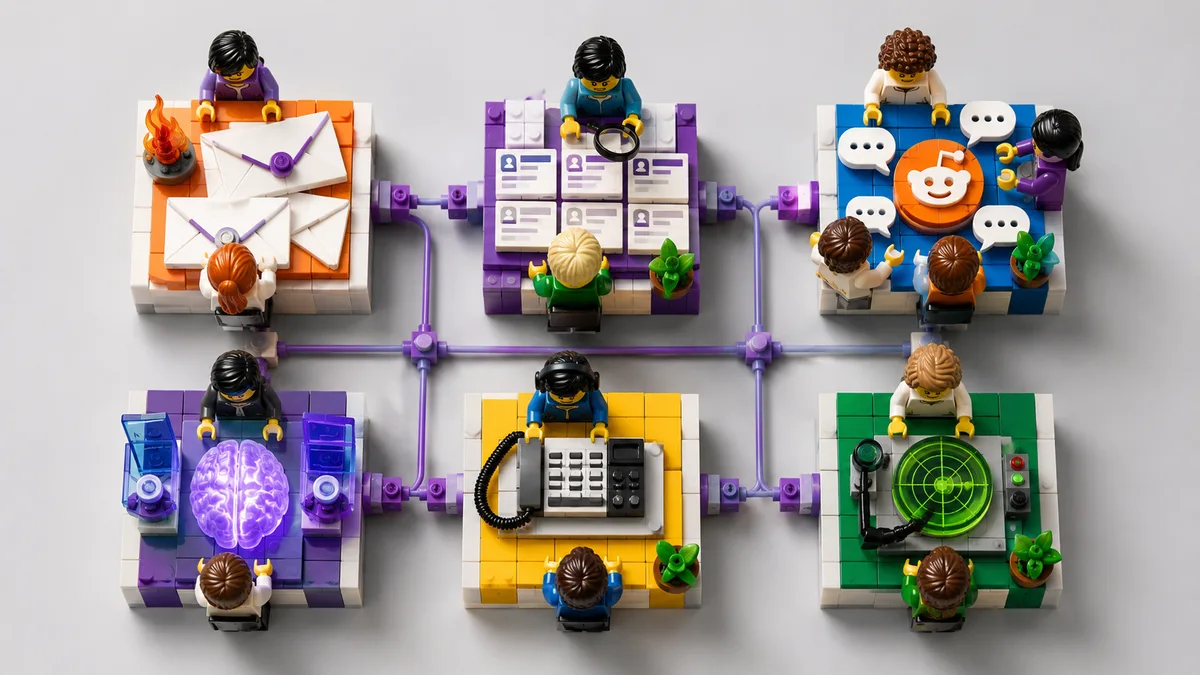
Brand monitoring in LLMs means tracking what ChatGPT, Perplexity, Claude, Gemini, and Grok say about your brand, the same way you would track mentions on social media, except the audience is an AI model instead of a person. A few months ago, I asked five different AI models to recommend social listening tools. I wanted to see where Buska showed up. The results were eye-opening. ChatGPT mentioned us in some prompts but not others. Perplexity cited us consistently but sometimes with outdated information. Claude and Gemini each had a different take. Grok barely knew we existed. That experiment revealed a massive blind spot: we were monitoring every mention of our brand on social media, but we had zero visibility into what AI models were telling people about us. And with AI-powered search volume climbing every month, that blind spot was costing us deals. This is the guide I wish I had before that experiment. It covers what brand monitoring in LLMs is, why it matters, what to track, and how to set it up.
What is LLM brand monitoring?
LLM brand monitoring is the practice of systematically tracking what large language models say about your brand, your products, and your competitors. It is the AI equivalent of brand monitoring on social media. But instead of tracking human conversations on Twitter and Reddit, you are tracking what AI models output when users ask questions relevant to your business.
When someone asks ChatGPT "what is the best project management tool for remote teams," the model generates an answer based on its training data and, in some cases, real-time web search. Your brand is either in that answer or it is not. LLM brand monitoring tells you which scenario is happening, across which models, for which prompts, and how your positioning compares to competitors.
Think of it this way. Traditional brand monitoring watches what humans say about you on social platforms. LLM brand monitoring watches what AI says about you when humans ask. Both signals matter. They are complementary, not competing. You need the human signal to understand market perception. You need the AI signal to understand AI-driven discovery, which is increasingly where purchase journeys begin.
Why LLM brand monitoring matters now
The urgency is driven by usage numbers that keep climbing. AI-powered search volume across ChatGPT, Perplexity, Gemini, and other platforms grows every month. A growing share of consumers now use AI at some point during their purchase research, according to research from Salesforce. For B2B buyers, that share is even higher in tech-adjacent industries.
But here is the part that makes this truly urgent: you have no control over what AI models say about you. With social media, you can post, reply, and shape the conversation. With search engines, you can optimize your pages. With AI models, the output is generated by an algorithm you cannot directly influence. You can only influence the inputs: the content, mentions, reviews, and data that models learn from.
Without monitoring, you do not even know if there is a problem. AI models sometimes hallucinate. They might attribute features to your product that do not exist, recommend competitors instead of you for queries where you are the better fit, or share pricing that is months out of date. If you are not checking, these errors compound silently.
- AI search volume keeps climbing across all major platforms. That is traffic your website never sees.
- A growing share of consumers use AI during purchase research, per Salesforce. For B2B tech, the figure is higher.
- AI hallucinations can misrepresent your product, pricing, or positioning with zero warning.
- Competitors may be optimizing for AI visibility while you focus solely on SEO and social.
- No notification system exists natively in AI models. You must monitor proactively.
AEO vs GEO vs SEO: three terms, three different goals
Three acronyms get thrown around together, and it is worth separating them before going further, because LLM brand monitoring only makes sense once you know which one you are actually measuring. SEO optimizes for ranking on a search results page. AEO (Answer Engine Optimization) optimizes for being selected as the single direct answer to a specific question, in a featured snippet, a voice assistant reply, or a Google AI Overview. GEO (Generative Engine Optimization) optimizes for being cited or recommended inside a longer, multi-source answer generated by a model like ChatGPT, Perplexity, or Claude.
| Term | Optimizes for | Where it shows up |
|---|---|---|
| SEO | Ranking on a results page | Google, Bing search results |
| AEO | Being the single direct answer to a question | Featured snippets, voice assistants, Google AI Overviews |
| GEO | Being cited or recommended inside a generated answer | ChatGPT, Perplexity, Claude, Gemini |
In practice the three overlap: the same structured, direct-answer content that wins a featured snippet is also what a generative model prefers to quote. What differs is how you measure success. SEO has rankings. AEO has snippet ownership. GEO has no equivalent native dashboard, which is exactly why LLM brand monitoring exists: it is the measurement layer for GEO, the same way Search Console is the measurement layer for SEO.
Which AI models to monitor
Not all AI models carry equal weight for your business, but you should monitor at least the five major ones. Each has different training data, update cycles, and citation patterns.
| AI model | Provider | Reach | Main data sources | Cites sources | Why monitor it |
|---|---|---|---|---|---|
| ChatGPT | OpenAI | 200M+ weekly users | Reddit, news, web + Bing search | Sometimes | Largest audience by far |
| Perplexity | Perplexity AI | Research-heavy users | Reddit, news, authoritative domains | Always | Transparent citations, popular in B2B research |
| Gemini | Inside Google AI Overviews | Google index + live web | Sometimes | Sits in the search results you already target | |
| Claude | Anthropic | Technical + business users | Curated web and documentation | Rarely | Used for deep product research |
| Grok | xAI | Growing X audience | Real-time X (Twitter) data | Sometimes | Live X conversations about your brand |
ChatGPT (OpenAI)
The largest by user count with 200M+ weekly active users. ChatGPT draws heavily from Reddit threads, news articles, and well-structured web content. It now has real-time search capabilities through Bing integration, which means its answers can change daily. ChatGPT is the single most important model to monitor because it reaches the most users.
Perplexity
Perplexity is built for research queries and always cites its sources. This makes it uniquely transparent: you can see exactly which URLs are being referenced. Perplexity pulls heavily from Reddit, news outlets, and authoritative domain-specific content. It is particularly popular among B2B buyers doing product research because it shows its work.
Gemini (Google)
Gemini is integrated directly into Google search through AI Overviews, which means it affects traditional search traffic. When Gemini answers a query directly in the search results, it reduces clicks to third-party websites. Monitoring what Gemini says is critical because it sits at the intersection of traditional SEO and AI-generated answers.
Claude (Anthropic)
Claude is increasingly popular among technical and business users. It tends to give nuanced, detailed responses and is often used for deep-dive product research. Claude's training data and response patterns differ from ChatGPT and Perplexity, so your brand may appear differently here.
Grok (xAI)
Grok has direct access to real-time X (Twitter) data, giving it unique visibility into current conversations. If your brand is actively discussed on X, Grok is more likely to reference those discussions in its answers. It is growing quickly and worth monitoring, especially if Twitter/X is a key platform for your audience.
What to monitor: the four dimensions
LLM brand monitoring is not just about checking if your name appears. There are four distinct dimensions you should track, and each tells a different story about your AI visibility.
1Brand mentions and visibility
How often does your brand appear in AI responses to relevant queries? This is the baseline metric. Track it across different prompt categories: product comparisons, feature-specific queries, pricing questions, and industry recommendations. A visibility score aggregated across all monitored prompts gives you a single number to track over time.
2Competitor mentions and share of voice
When AI mentions your competitors, it is equally informative. Track how often each competitor appears for the same prompts, and calculate your share of voice. If a competitor appears in 80% of responses and you appear in 20%, that gap is a strategic problem. Understanding competitive positioning in AI responses is just as important as tracking competitors on social media.
3Accuracy of AI responses
AI models sometimes get facts wrong. They may attribute incorrect features to your product, cite outdated pricing, or confuse you with a similarly named company. Monitoring accuracy helps you catch hallucinations before they mislead potential customers. When you find errors, you can take corrective action: updating your website content, adding structured data, or creating FAQ pages that give models better source material. We found a version of this in our own data: an internal audit in September 2026 discovered that 17 of our own pages had been telling AI engines the wrong plan limits, inside the FAQ structured data those engines read first, for months. The fix was not a complaint filed with ChatGPT. It was correcting our own source of truth, because AI engines echo whatever your site tells them, mistakes included.
4Sentiment and positioning
Beyond whether you appear, pay attention to how AI describes you. Is the sentiment positive, neutral, or negative? Does the model position you as a leader in your category or an afterthought? Does it highlight your strengths or focus on limitations? This qualitative layer matters because it shapes the user's perception before they ever visit your website.
Tools for LLM brand monitoring
You can start by manually querying AI models, but that does not scale. Manually checking five models for 20 different prompts daily is 100 queries, and you still need to record, compare, and analyze the results. Dedicated tools solve this problem.
Atyla: AI visibility tracking
Atyla is a GEO platform purpose-built for tracking brand visibility in AI search. It monitors your brand across 7 AI models including ChatGPT, Perplexity, Gemini, Claude, and Grok. You define the prompts that matter to your business (product comparisons, feature queries, industry recommendations), and Atyla checks how each model responds on a regular basis.
Atyla provides a visibility score that tracks your brand's presence over time, competitive analysis showing how you stack up against competitors in AI responses, and a GEO audit that identifies gaps in your content strategy. Plans range from 19 to 149 euros per month depending on the number of prompts and models tracked. For most B2B companies, the Starter plan at 19 euros per month covers the essentials.
Buska: social listening that feeds AI visibility
While Atyla tracks what AI says about you, Buska tracks what humans say about you across 30+ social platforms. This is not a competing tool. It is the other half of the equation. Social conversations on Reddit, Twitter, LinkedIn, and forums are the raw material that AI models learn from. More positive social mentions lead to better AI visibility over time. Buska detects buying signals and scores leads with AI. Together with Atyla, it gives you the complete monitoring stack.
Buska vs a dedicated AI citation tracker: what's the actual difference
To be direct about it: Buska does not read what ChatGPT or Perplexity answer when someone asks about your brand. That is a distinct product, built by Atyla and by players like Profound, Peec.ai, and Otterly.ai, who query AI models directly and score what comes back. Buska's job is the other half of the loop: catching the public posts, on Reddit, X, LinkedIn, and 30+ more platforms, that are the raw material those models learn from, and scoring which of those posters are buyers.
| Buska | AI citation tracker (Atyla, Profound, Peec.ai, Otterly.ai) | |
|---|---|---|
| Tracks | Public posts across 30+ social platforms | What AI models answer when prompted about your brand |
| Signal | Buying intent, before a purchase decision | Brand visibility, after the model has already formed a view |
| What it needs from you | Keywords and an ICP to watch | A list of prompts to check regularly |
How to set up LLM brand monitoring: step by step
- Define your prompt library. List 15-25 prompts that potential customers might ask AI models. Include product category queries ("best X for Y"), comparison queries ("X vs Y"), feature queries ("tool that does Z"), and brand-specific queries ("tell me about [your brand]").
- Run a baseline audit. Test each prompt across ChatGPT, Perplexity, Gemini, Claude, and Grok. Record whether your brand appears, what position it holds, and whether the information is accurate. This is your starting point.
- Set up automated monitoring. Use Atyla to automate daily checks across all models. Configure alerts for significant changes in visibility score or competitive positioning.
- Set up social listening. Use Buska to monitor brand mentions, competitor mentions, and category keywords across social platforms. This feeds the social signal that AI models learn from.
- Review weekly. Check your visibility dashboard, note trends, and identify prompts where you are losing ground. Prioritize content creation for gap areas.
- Correct errors. When you find AI models sharing inaccurate information about your brand, update the source material. Refresh your website FAQs, update product descriptions, and ensure consistency across all platforms.
- Track progress monthly. Compare your visibility score, share of voice, and accuracy metrics month over month. Adjust your content and GEO strategy based on what is working.
The complete monitoring stack for 2026
The brands winning in 2026 are not choosing between social listening and AI monitoring. They are running both. The stack is straightforward: Buska monitors the human layer (what people say on social media), and Atyla monitors the AI layer (what models say when asked). Social signals feed AI models. AI recommendations drive new users who create social signals. It is a loop, and you need visibility into both sides.
If you are already using Buska for social listening, adding Atyla takes 15 minutes to set up. Define your prompts, connect your brand, and you have full visibility. If you are starting from scratch, begin with Buska to capture the social signals that feed AI, then add Atyla to track how that translates into AI recommendations. The total investment starts at around 68 euros per month (Buska Starter at 49 euros plus Atyla Starter at 19 euros), which is a fraction of what a single missed deal costs.
Stop guessing what AI says about your brand. Monitor both human conversations and AI recommendations. Start with Buska for social listening, add Atyla for AI visibility, and get the complete picture.
Try Buska free for 7 days