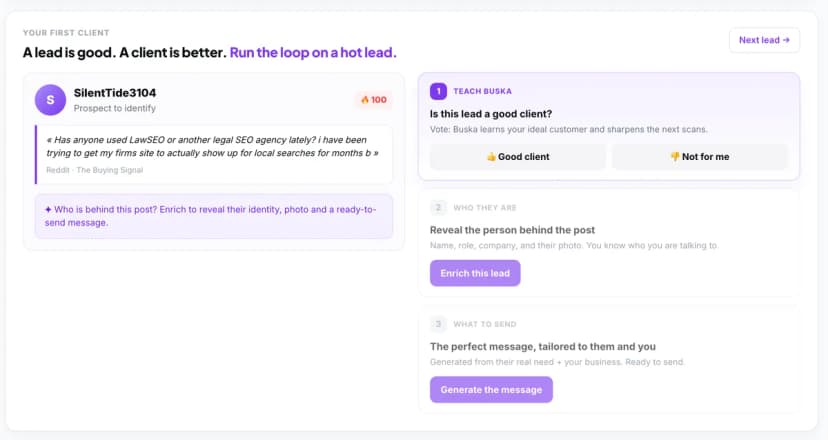
A buying intent signal is a social media post that reveals someone is ready to purchase, switch tools, or evaluate new solutions. Let me be honest: most social mentions are noise. But the ones that matter? They're worth their weight in pipeline. I remember our first real lead from Reddit -- someone asked for a social listening tool under $100/mo, and within 20 minutes we had a demo booked. This article breaks down the 5 signal types, ranks them by conversion potential, and shows how AI catches the ones you'd miss.
What even is a buying intent signal?
A buying intent signal is any public statement that suggests a person or company is actively looking for a product, considering alternatives, or ready to make a purchasing decision. These signals show up every day on Twitter, Reddit, LinkedIn, Hacker News, Quora, and dozens of other platforms. The problem? Most businesses don't have any systematic way to catch them.
Traditional monitoring tools track when someone mentions your brand. That's useful, but it's a tiny slice of the pie. Intent-based monitoring goes further -- it detects the motivation behind each post. Consider two messages that both mention 'CRM': one says 'Looking for a CRM that integrates with Slack' and the other says 'Just read an article about CRM trends.' Both mention the keyword. Only one signals a real buyer. If you can't tell the difference automatically, you're wasting your team's time on the wrong conversations.
Look at it this way: brand monitoring is a rearview mirror. Buying intent detection is a radar that shows you what's coming.
The 5 types (ranked by how likely they are to convert)
Buska classifies every social mention into one of five intent categories. Each type indicates a different level of buying readiness, and the AI scoring system prioritizes them accordingly. Here they are, from highest conversion potential to lowest:
| Intent type | What it means | Example post | Conversion potential |
|---|---|---|---|
| Active demand | Person is actively searching for a solution right now | "Looking for a project management tool that integrates with Slack" | Highest |
| Competitor frustration | Person is unhappy with a rival and considering alternatives | "Thinking about switching from Monday.com to something simpler" | High |
| Pain signal | Person is frustrated with the status quo, may not be shopping yet | "Our current CRM is terrible. Crashes every time I try to export" | Medium-high |
| Question or recommendation request | Person is asking peers for advice or tool suggestions | "Can anyone recommend a good invoicing tool for freelancers?" | Medium |
| Brand mention | Someone references your product by name | "Just tried Buska and the lead scoring is impressive" | Lower (awareness stage) |
The truth is, the first two categories are where the money is. When someone posts 'looking for a tool that does X' or 'need an alternative to Y,' they've already decided to buy something. The only question is what. If you show up with a thoughtful reply in the next hour, you've got a real shot.
How does AI detect intent without reading every post?
Buska uses a proprietary AI model trained on thousands of real buying signals since December 2023. The model doesn't rely on simple keyword matching. It reads full sentences, considers platform context, evaluates engagement levels, and cross-references the author's profile against your ICP. And it does all of this in real time, across 30+ platforms.
Here's why that matters: the phrase 'I need a new CRM' posted on a Reddit thread about software evaluations means something very different from the same phrase in a sarcastic tweet. A keyword-based tool treats them identically. Buska's model understands the difference and scores them accordingly.
- Natural language understanding: reads complete sentences and paragraphs, not just isolated keywords
- Platform context: a LinkedIn post from a VP of Sales carries more weight than an anonymous forum comment
- Engagement analysis: posts with genuine replies and upvotes indicate real conversations, not spam
- Freshness weighting: recent posts get priority because buying intent decays fast
- ICP matching: posts from people who match your Ideal Customer Profile score higher automatically
The model improves continuously as more signals are classified. Every time a team marks a lead as qualified or disqualified, the AI learns. It's not a static set of rules -- it gets sharper over time.
Why active demand signals convert 3x better than everything else
Not all intent is equal, and the gap's bigger than most people think. Active demand signals convert at roughly 3x the rate of generic brand mentions. The reason's simple: when someone posts 'I need a tool like yours,' they've already moved past awareness and into evaluation. They're not browsing. They're buying.
Responding within minutes makes the difference between winning a customer and losing them to whoever shows up next. Buying intent decays fast. A post from 2 hours ago is significantly more valuable than one from 2 days ago. That's why real-time alerts matter so much. If your team finds out about a buying signal 48 hours later, the prospect's probably already been helped (or sold to) by someone faster.
Teams that prioritize high-intent signals spend less time on unqualified conversations. Instead of reviewing hundreds of mentions manually, they focus on the 10 to 20 posts per week that represent real buying opportunities. Quality over quantity. Every single time.
How to actually respond to these signals
Finding the signal is only half the job. How you respond determines whether that signal becomes a customer or a missed opportunity. Early on at Buska, I replied to a Twitter thread about social listening tools with a two-paragraph breakdown of the market -- didn't even mention Buska until the prospect asked me directly. That became one of our longest-running customers. Here's the framework that works across platforms and industries.
- Track the right keywords: set up phrases that capture buying language. 'Looking for,' 'alternative to,' 'recommend a,' 'switching from,' and 'need a tool for' are strong starting points. You'll refine these within the first week.
- Filter by intent type first: have your team focus on active demand and competitor frustration signals before anything else. These have the highest conversion potential and deserve the fastest response.
- Respond fast, but respond well: speed matters, but a rushed generic pitch is worse than a thoughtful reply that arrives 30 minutes later. Reference the specific need they mentioned. Show you actually read their post.
- Lead with value, not a pitch: answer their question directly. Share a relevant insight. Mention your product only when it naturally fits. The goal is to be helpful first and promotional never (or at least second).
- Automate the pipeline, not the reply: connect Buska to your CRM via webhooks so that when a high-intent lead is detected, it appears in your sales pipeline automatically. But keep the human touch on the actual response.
Want to see what buying intent signals look like for your keywords? Start a free trial and find out in under 5 minutes.
Start detecting buying intent signals todayWhich platforms are goldmines for intent signals?
Based on data from over 2,000 teams using Buska, here's where B2B buying intent signals actually live. The answer might surprise you if you've been focusing all your energy on one platform.
| Platform | Signal volume | Intent quality | Best for |
|---|---|---|---|
| Twitter/X | High | Medium | Real-time conversations, competitor discussions, trending frustrations |
| Medium | High | Detailed buying questions, product comparisons, honest evaluations | |
| Medium | Very high | Decision-maker signals, professional context, ICP-rich data | |
| Hacker News | Low | Very high | Developer tools, SaaS evaluations, technical buyer conversations |
| G2 and Trustpilot | Low | High | Review-based intent, competitor frustration, active comparison shoppers |
| Quora | Medium | Medium-high | Question-based intent, early research phase, problem descriptions |
LinkedIn has the highest intent quality because every post comes from a real professional with a job title, company, and context you can verify. A VP of Marketing posting about needing a new analytics tool is a stronger signal than an anonymous Reddit user asking the same question. But don't ignore Reddit -- the intent depth there is unmatched because users write multiple paragraphs explaining exactly what they need.
How Buska scores intent from 0 to 100
Every mention that Buska captures receives a score from 0 to 100. The score isn't a single metric -- it's a composite of several factors designed to surface the leads most likely to convert. Leads scoring 60 or above are marked as Hot and should be acted on immediately. Leads between 35 and 59 are Warm and worth monitoring. Below 35 is Cold.
Here's what goes into it:
- AI qualification: the proprietary model assigns a buying intent rating based on language analysis and context
- Intent category: active demand and competitor frustration signals get a significant score boost
- Freshness: a post from the last hour scores much higher than one from last week, because intent decays
- ICP match: leads whose profile matches your Ideal Customer Profile receive a score bump
- Platform weight: professional platforms like LinkedIn contribute more than anonymous forums
The scoring model improves continuously. As your team marks leads as qualified or irrelevant, the AI adapts to your specific use case. After a few weeks, the scoring becomes highly accurate for your particular market.
Real examples that our AI detected this week
Numbers and theory are fine, but nothing beats seeing real signals. These are the types of posts Buska catches daily across 30+ platforms. Each one shows the intent classification and the score the AI assigned.
- Score 92 (Active demand): 'We need a social listening tool that can track Reddit and LinkedIn. Budget approved for Q2.' Posted on LinkedIn by a Head of Growth.
- Score 85 (Competitor frustration): 'Anyone else frustrated with Mention.com? Looking for a better alternative with AI scoring.' Posted on Twitter/X.
- Score 78 (Pain signal): 'Our current lead gen process is completely manual. Spending 3 hours a day on Twitter searching for prospects.' Posted on Reddit in r/startups.
- Score 65 (Question): 'What tools do growth teams use to monitor social media for leads? Curious what's working in 2026.' Posted on Hacker News.
- Score 30 (Brand mention): 'Just saw Buska mentioned in a newsletter about social listening tools.' Posted on Twitter/X.
Notice the difference between the score 92 lead and the score 30 mention. The first one has budget, a timeline, and a clear need. The second is just awareness. Both are worth tracking, but only one deserves an immediate, personalized response. That's what scoring is for.
See what buying signals exist for your keywords right now. Free 7-day trial, no credit card required.
Start detecting buying intent signals today