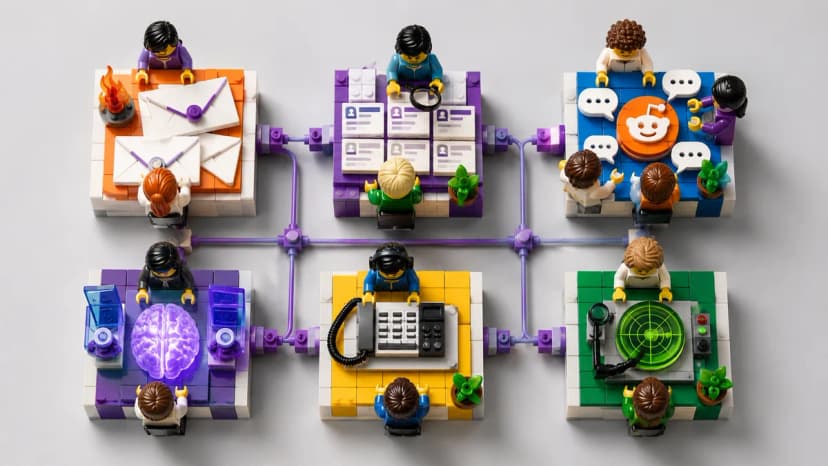
Social listening tools monitor social media platforms for buying signals and brand mentions in real time. Google Alerts monitors web pages and blog posts for keyword matches and sends digest emails. When we first started building Buska, I actually used Google Alerts alongside our own tool for a month. I wanted to be fair about what each one could do. We tested both approaches for 30 days on the same set of keywords to see which one actually finds leads. Here are the results, no sugarcoating.
What exactly does Google Alerts do (and what does it miss)?
Google Alerts is a free monitoring tool that sends you email notifications when new web pages matching your keywords are indexed by Google. It's simple, reliable for what it does, and costs nothing. For tracking press mentions, blog posts, and news articles, it works fine. The problem is what it doesn't do.
Google Alerts doesn't monitor social media. It doesn't track Twitter, Reddit, LinkedIn, Hacker News, Quora, or any platform where buyers actually discuss their needs. It only catches content that Google indexes, which excludes most social conversations. It also sends digest emails (daily or weekly), which means you might see a mention 24 to 48 hours after it was posted. For brand monitoring, that delay's tolerable. For lead generation through social listening, it's a dealbreaker.
Look, Google Alerts is a great tool for 2010. For 2026 lead generation, it misses the platforms where buyers actually talk.
How did we set up the test?
We wanted a fair comparison, so we used identical keywords on both tools for 30 days. No cherry-picking. The test tracked 10 keywords across both Google Alerts and Buska, measuring total mentions found, platform coverage, delivery speed, and the number of mentions that represented actual buying intent.
The keywords included brand names (Buska, two competitor names), category terms ('social listening tool,' 'lead generation software'), and buying phrases ('looking for a social listening tool,' 'alternative to Mention'). We ran both tools simultaneously from February 1 to March 1, 2026.
- We set up 10 identical keywords on both Google Alerts and Buska.
- Google Alerts was configured for 'as-it-happens' delivery (the fastest option available).
- Buska was configured with real-time alerts via Slack and email.
- Every mention from both tools was logged in a spreadsheet with timestamp, platform, and content.
- Each mention was manually classified as 'buying intent,' 'brand mention,' or 'noise.'
What were the results after 30 days?
Spoiler: the gap was way larger than we expected. Buska detected 8x more total mentions and 23x more buying intent signals than Google Alerts over the same 30-day period. The difference is almost entirely explained by platform coverage. Google Alerts simply doesn't monitor the platforms where buying conversations happen.
| Metric | Google Alerts | Buska | Difference |
|---|---|---|---|
| Total mentions found | 47 | 389 | 8.3x more with Buska |
| Buying intent signals | 3 | 69 | 23x more with Buska |
| Platforms monitored | Web pages and blogs only | 30+ including Twitter, Reddit, LinkedIn | Full social coverage |
| Average delivery speed | 6 to 24 hours | Under 15 minutes | Real-time vs digest |
| False positives (noise) | 18 out of 47 (38%) | 42 out of 389 (11%) | Lower noise rate with AI scoring |
| AI intent scoring | None | 0 to 100 score per mention | Automatic prioritization |
| Monthly cost | Free | $49 to $249 per month | Paid but significantly more capable |
The 3 buying intent signals Google Alerts found were all from blog posts that happened to mention our keywords in a comparison article. None of them were direct buying signals from real prospects. The 69 intent signals Buska found included 41 from Twitter, 16 from Reddit, 8 from LinkedIn, and 4 from other platforms. These were real people expressing real needs. Honestly, running this test was what convinced me to stop recommending Google Alerts to anyone asking about lead gen.
Where does Google Alerts still make sense?
Let's be fair. Google Alerts isn't worthless. Google Alerts is still useful for tracking press coverage, blog mentions, and SEO competitor monitoring, but it's fundamentally the wrong tool for lead generation. If your goal is knowing when a journalist writes about your industry or when a competitor publishes a new blog post, Google Alerts does that for free. And that's great.
- Press monitoring: Google Alerts catches news articles and press releases reliably
- Blog tracking: useful for seeing when competitors publish new content
- SEO research: helps identify which sites mention your target keywords
- Brand protection: catches unauthorized use of your brand name on web pages
For these use cases, Google Alerts is fine. But if your goal's finding people who are actively looking for a solution like yours, you need a tool that monitors where those conversations actually happen: social media. That's the fundamental gap.
See what Google Alerts is missing. Try Buska on the same keywords and compare the results yourself. Free 7-day trial.
Try Buska free for 7 daysHow do dedicated social listening tools compare to each other?
If you've decided that Google Alerts isn't enough (and after reading the data above, you probably have), the next question is which social listening tool to choose. The market includes brand monitoring tools, social analytics platforms, and lead generation tools. They aren't the same thing, and the difference between social listening and social monitoring matters.
| Feature | Buska | Mention | Brand24 | Google Alerts |
|---|---|---|---|---|
| Focus | Lead generation | Brand monitoring | Brand monitoring | Web monitoring |
| Platforms monitored | 30+ | 14+ | 25+ | Web only |
| AI intent scoring | Yes (0-100) | No | No | No |
| ICP matching | Yes | No | No | No |
| Real-time alerts | Yes (Slack, email, webhook) | Yes (email, Slack) | Yes (email) | Digest only |
| CRM integrations | HubSpot, Salesforce, Pipedrive | Limited | Limited | None |
| Reply Studio | Yes | No | No | No |
| Starting price | $49/month | $41/month | $79/month | Free |
The key distinction is focus. Mention and Brand24 are excellent tools for understanding how your brand is perceived online. Buska is built specifically for turning social conversations into pipeline. If your goal is sentiment analysis and brand health, choose a brand monitoring tool. If your goal is finding and converting leads, choose a lead generation tool.
What should you look for in a social listening tool for lead gen?
Not all social listening tools are designed for lead generation. Most are built for brand monitoring, PR, and sentiment analysis. When you're evaluating a social listening tool for lead gen, the three features that matter most are: AI intent scoring, ICP matching, and CRM integration. Without these, you're still doing the heavy lifting manually.
- AI intent scoring: the tool should classify each mention by buying intent, not just show you a keyword match. Without scoring, you drown in noise.
- ICP matching: the tool should match the author's profile against your Ideal Customer Profile. A perfect keyword match from the wrong person is a waste of time.
- CRM integration: qualified leads should flow directly into your pipeline (HubSpot, Salesforce, Pipedrive). Manual copy-paste kills velocity.
- Real-time alerts: buying intent decays fast. A daily digest is too slow for lead gen. You need Slack or email alerts within minutes.
- Multi-platform coverage: your buyers are on Twitter, Reddit, LinkedIn, and other platforms. A tool that only monitors one or two platforms will miss signals.
Buska checks all five boxes. It was built from the ground up for lead generation, not adapted from a brand monitoring tool. That focus shows in the feature set, the scoring model, and the integrations.
Google Alerts missed 23x more buying signals than Buska in our 30-day test. See what it's missing for your keywords. Free trial, no credit card.
Start your free trial