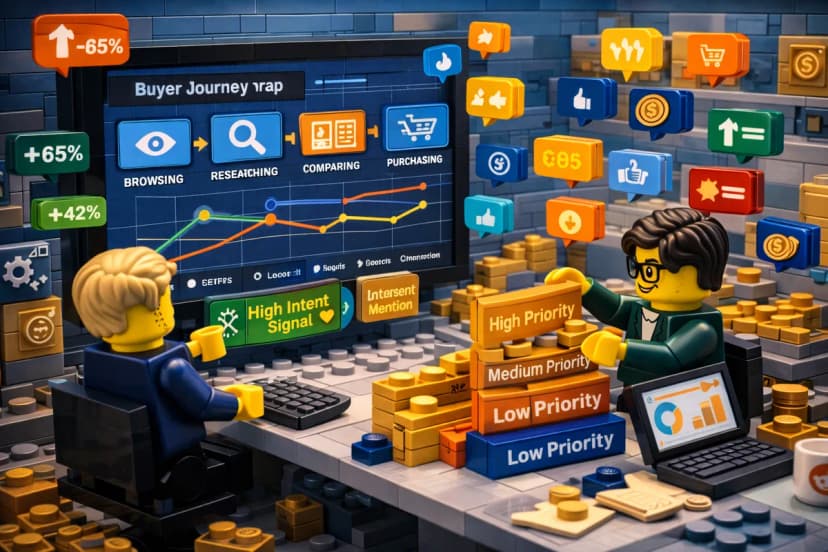
Imagine knowing which companies are actively researching your product category before they ever visit your website. That is the promise of intent data. It tells you who is showing signals of buying interest, what they are researching, and where they are in their buying journey. The reality is more nuanced than the pitch decks suggest, but intent data, when used correctly, is one of the most powerful tools in modern B2B sales and marketing. This guide covers the real definition, the different types of intent data, where it comes from, how to use it, and what it actually costs.
What is intent data?
Intent data is information collected about a person's or company's online behavior that signals an intention to purchase a product or service. It goes beyond demographic or firmographic data (who they are) to capture what they are actively doing: what topics they are researching, what content they are consuming, what questions they are asking, and what products they are evaluating. For a practical walkthrough, see our guide on what intent signals are and how to detect them.
The core idea is simple: if a company's employees are consuming an unusual amount of content about "social listening tools" compared to their baseline, that company is probably evaluating social listening tools. If you sell social listening tools, you want to know about it.
Types of intent data
First-party intent data
First-party intent data comes from your own properties: your website, your app, your emails. It tells you what people are doing within your ecosystem. Examples include repeated visits to your pricing page, downloading multiple case studies, signing up for a webinar, starting a free trial, or engaging with outreach emails. This data is free (you already have it), high quality (directly relevant), and privacy-compliant (you collected it with consent). The limitation is scope: it only covers people who already know about you.
Third-party intent data
Third-party intent data comes from external sources: publisher networks, data cooperatives, review sites, and aggregators. It tells you what people are doing across the broader web, not just on your properties. For example, a third-party provider might tell you that employees at Company X have been reading articles about "best social listening tools" on TechCrunch, G2, and three industry blogs over the past two weeks. This data reveals demand you would never see from first-party data alone, but it is more expensive, less precise, and raises more privacy questions.
Social intent data
Social intent data is a category that deserves its own spotlight. It comes from public conversations on social media platforms: Twitter, Reddit, LinkedIn, forums, and review sites. When someone tweets "looking for a better CRM," that is social intent data, and more specifically it is a buying signal. When someone posts on Reddit asking for alternatives to a competitor, that is social intent data too. It is real-time, high-intent, and publicly available. Unlike third-party behavioral data, you do not need to rely on cookie tracking or IP matching. The person told you what they want, in their own words. Social listening tools are what make it possible to capture these signals at scale.
First-party vs. third-party vs. social intent data
| **Aspect** | **First-Party** | **Third-Party** | **Social Intent** |
|---|---|---|---|
| Source | Your website/app | External publisher networks | Public social platforms |
| Cost | Free (already yours) | $$$$ (vendor contracts) | $ - $$ (social listening tools) |
| Accuracy | High | Medium (IP/cookie based) | High (self-declared intent) |
| Timeliness | Real-time | Days to weeks lag | Real-time |
| Scope | Only your visitors | Broad web behavior | Public conversations only |
| Privacy | Consent-based | Cookie/IP dependent | Public data |
| Example | Pricing page visits | Content consumption spikes | "Anyone recommend a [tool]?" |
How to use intent data
- Prioritize outbound prospecting. Instead of cold-calling a random list, focus on companies showing intent signals. Your reps reach out to people who are already thinking about your category, making the conversation warmer and the conversion rate higher.
- Trigger personalized campaigns. When a company's intent score spikes, automatically enroll them in a targeted email sequence, retargeting campaign, or ABM play. The messaging can reference the specific topic they are researching.
- Score and qualify leads. Add intent signals to your lead scoring model. A lead that matches your ICP and is actively researching your category should score higher than a lead that matches your ICP but shows no behavioral signals.
- Time your outreach. Intent data tells you when a company is in-market, not just if. Reaching out during the research phase (not before, not after) dramatically improves response rates.
- Competitive positioning. If intent data shows a prospect researching your competitor, you can proactively position against them. If they are reading reviews of your competitor on G2, send them a comparison guide. For teams doing account-based marketing, our ABM social listening guide shows how to combine intent data with targeted outreach.
Intent data tools and providers
The market has several categories of intent data providers, each with different approaches and price points.
- Buska - Social intent data from Twitter, Reddit, LinkedIn, and 15+ platforms. AI scoring identifies buying signals in real-time. Starting at $49/month. Best for teams that want real-time, self-declared intent from social conversations.
- Bombora - The largest B2B intent data cooperative. Tracks content consumption across a network of 5,000+ publisher sites. Enterprise pricing (typically $25k-$100k+/year). Best for large sales teams doing ABM at scale.
- G2 - Buyer intent based on product research and comparison activity on G2's review platform. Pricing varies by tier. Best for companies in categories actively reviewed on G2.
- 6sense - AI-powered intent and predictive analytics platform. Combines multiple data sources. Enterprise pricing ($50k+/year). Best for large organizations with dedicated revenue operations teams.
- ZoomInfo - B2B data platform with intent signals from web behavior. Enterprise pricing. Best for teams that also need contact and company data alongside intent.
- LinkedIn Sales Navigator - Shows buyer intent signals within LinkedIn (profile views, content engagement, job changes). Starting at $99/month. Best as a complement to other intent sources for LinkedIn-heavy B2B sales.
How much does intent data cost?
The cost range is enormous. Here is a realistic breakdown.
- Free: First-party data from your website analytics and CRM. Google Alerts for basic web mentions. Limited but valuable.
- $50-$300/month: Social intent tools like Buska. Real-time signals from social platforms with AI scoring. Best value for startups and mid-market companies.
- $1,000-$5,000/month: Mid-tier intent providers and bundled data platforms. More data sources and integrations.
- $25,000-$100,000+/year: Enterprise intent platforms like Bombora, 6sense, and Demandbase. Massive datasets, deep integrations, dedicated support. Only makes sense for companies with large sales teams and ABM programs.
The key question is not "how much does it cost?" but "what is the cost per qualified lead?" A $49/month tool that surfaces 10 qualified leads per month is a better investment than a $5,000/month tool that surfaces 15. Calculate ROI based on deals closed, not data volume.
Start with social intent data. Buska finds buying signals across 15+ platforms, starting at $49/month.
Try Buska free for 7 days