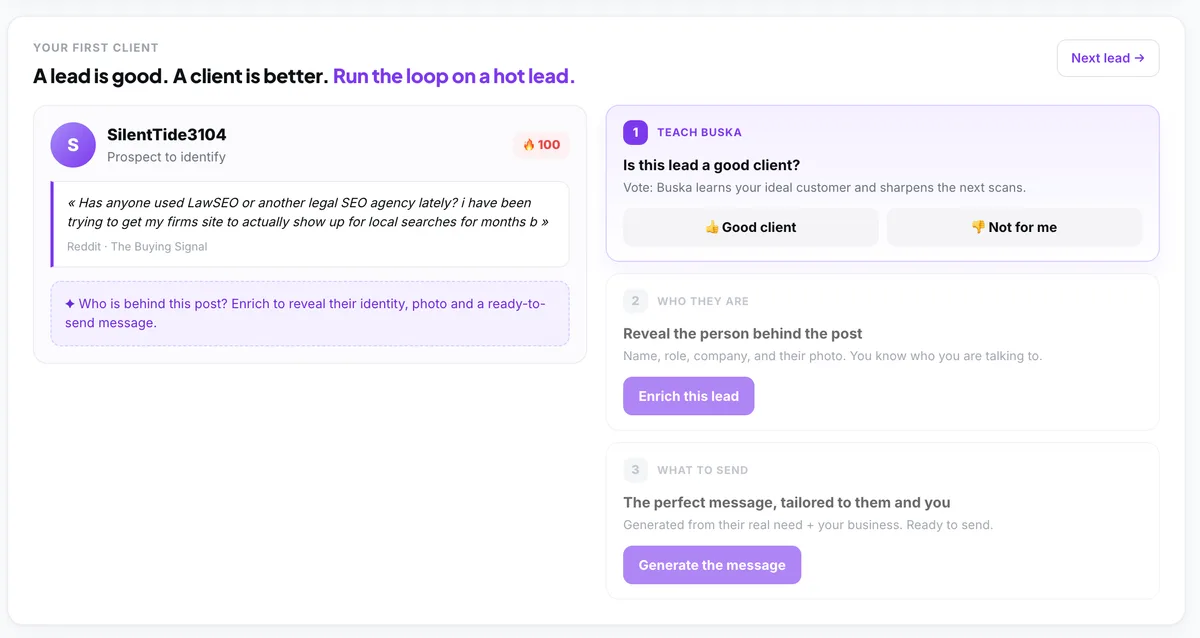
Buying intent data from providers like Bombora, 6sense, or ZoomInfo costs a B2B sales team between $25K and $150K per year. They get spreadsheets of account names that supposedly show "purchase intent" based on IP-level web browsing behavior. Some of those signals are genuinely useful. Many are stale, noisy, or impossible to act on. Meanwhile, real buyers are posting on Twitter, Reddit, and LinkedIn right now, publicly asking for recommendations, complaining about competitors, and describing the exact problem your product solves. Those conversations are buyer intent data too, and you can capture them for a fraction of the cost. This guide covers every type of intent data, where it comes from, how to use it, and what it actually costs. Whether you run a 200-person sales org or a 3-person startup, you will walk away knowing exactly which approach fits your budget and your workflow.
What is buyer intent data?
Buyer intent data is information that indicates a person or company is actively researching, evaluating, or preparing to purchase a product or service. It goes beyond basic demographics or firmographics. Instead of telling you that a company has 500 employees and is based in Austin, intent data tells you that someone at that company has been reading articles about CRM migration, visiting competitor pricing pages, or posting on Reddit asking for tool recommendations.
The core value proposition is simple: sell to people who are already buying. Cold outreach works on volume. Intent data works on precision. When you know that a prospect is in an active buying cycle, your outreach becomes relevant instead of interruptive. Replies come easier because you are reaching out at the right moment with the right message.
If you are new to this topic, our glossary entry on what intent data is covers the basics. This guide goes deeper into the practical side: which types of intent data exist, what they cost, and how to build a workflow around them.
The 3 types of buyer intent data
Not all intent data is created equal. The industry generally divides it into three categories, each with different strengths, limitations, and price points.
1First-party intent data
First-party intent data comes from your own properties. It is the behavior of people interacting directly with your website, product, content, or emails. Examples include: someone visiting your pricing page three times in a week, a free trial user who activates a premium feature, a contact who opens every email in your nurture sequence, or a prospect who downloads a buyer's guide.
This is the most reliable type of intent data because you control the source and the signal is clear. The main limitation is reach. First-party data only captures people who have already found you. It tells you nothing about the thousands of potential buyers who are researching your category but have never visited your website.
2Third-party intent data
Third-party intent data comes from external providers who aggregate browsing behavior across a network of B2B publisher websites. Bombora, for example, tracks content consumption across 5,000+ B2B media sites through their Data Co-op. When employees at a company start reading more articles about "cloud migration" or "sales automation" than their baseline, Bombora flags that company as showing intent for those topics.
The technology typically works through a combination of IP address reverse lookup, cookie tracking, and publisher data-sharing agreements. Companies like 6sense and ZoomInfo add their own proprietary data layers, including technographic data, job postings analysis, and hiring signals. The output is usually an account-level intent score: "Company X is showing high intent for Topic Y."
Third-party data is powerful for identifying accounts you have never heard of. The downside is that it works at the company level, not the individual level. You learn that "Acme Corp is researching CRM solutions," but you do not know which person at Acme Corp is doing the research. You still need to figure out who to contact. Accuracy can also vary. IP-based identification has become less reliable as more employees work from home, and cookie deprecation continues to erode tracking signals.
3Social intent data
Social intent data is the newest category. It captures public conversations where people express buying intent directly. Someone tweeting "We just outgrew Notion, what project management tools do you all use?" is a buyer intent signal. Someone posting on a subreddit asking "Best CRM for a 20-person sales team?" is a buyer intent signal. A LinkedIn comment saying "We are evaluating alternatives to HubSpot" is a buyer intent signal.
Social intent is fundamentally different from third-party intent. Instead of inferring that someone might be interested based on their browsing patterns, you are reading their own words. The signal is explicit, attributed to a real person (not just a company), and public the moment it is written. Tools like Buska monitor 30+ platforms for these conversations, scoring each mention for purchase intent so sales teams can prioritize the most promising leads.
The trade-off is coverage. Not every buyer posts publicly about their purchase process. Social intent data captures the vocal segment of the market, which in B2B is substantial (especially on LinkedIn, Twitter, Reddit, and Hacker News), but it does not capture the silent researchers who browse privately.
Comparison: the 3 types side by side
| First-Party | Third-Party | Social Intent | |
|---|---|---|---|
| Data source | Your website, product, emails | B2B publisher network, IP tracking | Public social platforms (Twitter, Reddit, LinkedIn, forums) |
| Signal level | Individual (known contacts) | Account-level (company name) | Individual (real person with profile) |
| Signal type | Behavioral (page visits, clicks) | Inferred (content consumption patterns) | Declared (self-expressed needs) |
| Timing | Real-time | Weekly batch (typically) | Real-time |
| Reach | Limited to your existing audience | Broad (millions of accounts) | Moderate (active social users) |
| Accuracy | High (direct behavior on your site) | Variable (IP resolution, cookie issues) | High (reading their own words) |
| Typical cost | Free (you own the data) | $15K-$150K/year | $49-$249/month |
| Best for | Scoring existing pipeline | Account-based marketing at scale | Finding new leads and timing outreach |
Where buyer intent data comes from
Understanding the sources behind intent data helps you evaluate which signals are worth acting on. Here is a breakdown of the most common sources, grouped by reliability and accessibility.
Review sites (G2, Capterra, TrustRadius)
When someone visits a G2 comparison page for "CRM software" and views your profile alongside three competitors, that is strong intent. G2 and TrustRadius both offer buyer intent programs that notify vendors when prospects research their category. These signals are high quality because the person is explicitly comparing products. The downside: G2 intent data is expensive ($20K+ per year) and only covers their platform.
Social platforms (Twitter, Reddit, LinkedIn, Hacker News)
Social platforms are a goldmine for buyer intent. In our study of 451,903 public posts, Reddit alone produced 312,703 signal-matching posts in 60 days, about 5,200 a day, and 77.0% of every post tagged with strong buying intent. Twitter is where founders and operators publicly discuss their tech stacks, pain points, and vendor evaluations. LinkedIn is where decision-makers announce new initiatives, budget approvals, and role changes that indicate buying cycles. Hacker News surfaces technical evaluations and infrastructure decisions.
The challenge with social sources is volume. Manually monitoring these platforms is not scalable. You need a tool that tracks relevant keywords across platforms and surfaces the high-intent conversations. That is exactly what intent signals detection is designed to solve.
Search behavior and content consumption
When someone searches Google for "best project management software for remote teams 2026" or "Asana vs Monday.com pricing," they are showing intent. This is the data that traditional third-party providers capture through publisher co-ops: which companies are consuming more content about a given topic than usual. Search intent data is useful at scale but becomes less granular at the individual level.
Technographic changes and hiring signals
When a company removes a competitor's technology from their website (detectable through tools like BuiltWith or Wappalyzer), that is a strong churn signal. When they post a job listing for "Salesforce Admin" or "HubSpot Implementation Specialist," they are signaling a technology investment. Hiring data from LinkedIn and job boards is an underused source of intent data because it indicates budget allocation and organizational commitment, not just casual browsing.
How to use buyer intent data for lead generation
Collecting intent data is one thing. Turning it into pipeline is another. Here is a practical, step-by-step workflow that works whether you are using enterprise intent tools or a $49/month social listening setup.
Step 1: Identify your high-intent keywords
Start by listing the phrases that a buyer in your market would use when actively looking for a solution. These fall into a few patterns: direct requests ("looking for a CRM," "need a project management tool"), comparison queries ("HubSpot vs Salesforce," "alternative to Mailchimp"), pain-point descriptions ("our email deliverability is terrible," "we keep losing deals because of slow follow-up"), and competitor mentions with dissatisfaction ("frustrated with Zendesk," "switching from Intercom").
Be specific. "CRM" is too broad. "Best CRM for B2B SaaS startups under 50 employees" is a high-intent keyword. The more specific the query, the stronger the buying signal. For a deeper framework on identifying these signals, see our guide on buying signals with real examples.
Step 2: Set up monitoring across sources
Once you have your keyword list, you need to monitor them consistently. For first-party data, tools like HubSpot, Mixpanel, or Amplitude track website and product behavior. For third-party data, providers like Bombora or 6sense deliver weekly reports. For social intent, Buska lets you set up keywords and monitors 30+ platforms, delivering new mentions to your dashboard, Slack, or email after each scan (hourly on Scale, every 3 hours on Growth, daily on Starter).
The key is not to rely on a single source. The most effective intent data strategies layer multiple signals. A prospect who shows up in your Bombora report AND is posting on LinkedIn about switching tools is a much stronger lead than someone who only appears in one source.
Step 3: Score and prioritize signals
Not every intent signal deserves the same response. A Reddit post asking for software recommendations from someone with a VP title at a company in your ICP is worth a personal reply within the hour. A vague tweet about "thinking about improving our sales process" from an unknown account might be worth bookmarking but not dropping everything for.
Build a simple scoring framework. Weight signals based on: explicitness (are they directly asking for a product vs. mentioning a problem?), recency (today vs. two weeks ago), authority (decision-maker vs. intern), and ICP fit (right company size, industry, and use case). If you want to go deeper on scoring frameworks, our guide on lead scoring covers the complete methodology.
Not sure how a specific post would score? Buska's free Buying Intent Checker applies this same weighting to any text you paste and returns a 0-100 score with the reasoning behind it.
Step 4: Personalize outreach based on the signal
This is where most teams fail. They collect intent data and then send the same generic sequence to everyone. The whole point of intent data is personalization. If someone posted on Reddit asking for CRM recommendations, your reply should reference that specific post, acknowledge their stated requirements, and explain how your product addresses them. Do not send a template.
The same applies to third-party intent data. If Bombora tells you that a company is researching "sales automation," your SDR's outreach should reference a specific sales automation challenge that company might face, not a generic "I see you might be interested in our product" opener. The signal gives you context. Use it. For the difference between marketing-qualified and sales-qualified leads in this context, see MQL vs SQL.
Intent data providers compared
The buyer intent data market ranges from enterprise platforms costing six figures to lightweight tools accessible to any startup. Here is an honest breakdown of the major providers.
Bombora
Bombora is the largest provider of B2B intent data, powering the intent signals in many other tools (including some features within 6sense and Demandbase). Their Data Co-op collects content consumption data from 5,000+ B2B publisher websites. Bombora is strong on breadth: they cover most industries and topics. Pricing starts around $25,000 per year and scales with data volume and integrations. Best suited for mid-market and enterprise teams running account-based marketing programs.
6sense
6sense positions itself as a "Revenue AI" platform that combines intent data with account identification, predictive analytics, and orchestration. Their intent data includes Bombora signals plus their own proprietary data from web scraping and partnership networks. 6sense is the most full-featured platform in this category, but it is also the most expensive. Annual contracts typically start at $50,000 and can exceed $150,000 for larger implementations. Best suited for enterprise B2B teams with dedicated RevOps resources.
ZoomInfo
ZoomInfo combines a massive B2B contact database with intent data (built on their acquisition of Clickagy; their earlier data partnership with Bombora ended in 2020). Their strength is the combination: you get the intent signal AND the contact information to act on it in one platform. Pricing starts around $15,000 per year for basic packages, but full access to intent features and larger data sets pushes costs significantly higher. Best for sales teams that need both intent signals and contact data in one tool.
Buska
Buska takes a fundamentally different approach. Instead of tracking anonymous browsing behavior, it monitors public social conversations for buyer intent. You set up keywords related to your product, competitors, or market problems, and Buska scans Twitter, Reddit, LinkedIn, Hacker News, and 25+ other platforms for relevant mentions. Each mention gets an intent score so you can prioritize responses. Plans start at $49 per month.
It is important to be clear about what Buska does and does not do. Buska does not give you the account-level intent scores or ABM orchestration that Bombora or 6sense provide. It does not have a contact database like ZoomInfo. What it does is surface real, attributable conversations from real people expressing real needs. For startups and SMBs that cannot justify five-figure annual contracts, social intent is often the most actionable and cost-effective path to intent-driven selling. For a deeper, feature-by-feature breakdown of the three enterprise platforms, see our 6sense vs Bombora vs ZoomInfo comparison.
| Provider | Type | Signal Level | Pricing Range | Best For |
|---|---|---|---|---|
| Bombora | Third-party (publisher co-op) | Account-level | $25K-$60K/year | ABM programs, mid-market+ |
| 6sense | Third-party + predictive | Account-level | $50K-$150K+/year | Enterprise RevOps teams |
| ZoomInfo | Third-party + contact DB | Account + contact | $15K-$40K+/year | Sales teams needing contacts + intent |
| G2 Buyer Intent | Review site behavior | Account-level | $20K-$50K/year | SaaS companies listed on G2 |
| Buska | Social intent (public conversations) | Individual-level | $49-$249/month | Startups, SMBs, social selling teams |
Social intent vs. traditional intent data
The rise of social intent data has created a genuine alternative to traditional third-party providers. Here is where each approach wins.
Speed: real-time vs. weekly batch
Traditional intent data providers typically deliver signals in weekly or bi-weekly batches. You receive a list of accounts that showed intent during the previous period. By the time your SDR acts on it, the prospect may have already signed with a competitor. Social intent data is live: the post is public the moment it is written. A tool that scans every hour or every day gets you into the thread while it is still open, not weeks later. In competitive markets, that speed difference changes outcomes.
Accuracy: self-declared vs. IP-inferred
Third-party intent data infers intent from browsing behavior. If employees at Acme Corp read 5 articles about "cloud security" this week, the provider flags Acme Corp as showing intent for cloud security. But that inference can be wrong. Maybe the IT team was researching a blog post they are writing. Maybe an intern was doing coursework. The signal is statistical, not definitive. Social intent data captures what people explicitly say. When someone writes "We need to replace our current helpdesk software by Q3," there is no ambiguity. They stated their intent in their own words.
Cost: a different order of magnitude
This is the most dramatic difference. Enterprise intent data platforms cost $15,000 to $150,000 per year. A social intent tool like Buska costs $588 to $2,988 per year. For a startup or small sales team, that is not a rounding error. It is the difference between being able to use intent data at all and not having access to it. For teams with the budget, the optimal approach is to combine both: use traditional intent data for broad account identification and social intent for real-time, individual-level signals.
Signal attribution: company vs. person
Traditional third-party data tells you a company is interested. Social intent data tells you a person is interested. That distinction matters for outreach. With account-level data, your SDR still needs to figure out who the right contact is at the company, what their role is, and what specifically triggered the intent signal. With social intent data, you already know the person, their role (from their profile), and their specific need (from their post). The path from signal to personalized outreach is shorter.
| Traditional (Third-Party) | Social Intent | |
|---|---|---|
| Delivery speed | Weekly/bi-weekly batches | Hourly to daily scans of posts that are public instantly |
| Signal source | Browsing behavior on B2B sites | Public social conversations |
| Accuracy | Inferred (statistical models) | Declared (their own words) |
| Attribution | Company name | Individual person with profile |
| Annual cost | $15K-$150K | $600-$3K |
| Scale | Millions of accounts | Depends on social activity in your market |
| Privacy concerns | Moderate (cookie/IP tracking) | Low (public data only) |
| Best combined with | ABM platforms, CRM enrichment | Social selling, personalized outreach |
5 buyer intent signals you can detect today
You do not need an enterprise platform to start using buyer intent data. Here are five signal types you can begin detecting immediately, with real examples.
1Direct recommendation requests
"Can anyone recommend a good email marketing tool for an e-commerce brand doing $2M ARR?" These posts appear daily on Twitter, Reddit, LinkedIn, and industry Slack communities. They represent the highest-intent signal available because the person is openly asking for exactly what you sell. Responding within the first hour dramatically increases your chances of being considered. Set up keyword monitoring for phrases like "recommend," "looking for," "need a tool," and "any suggestions" combined with your product category.
2Competitor dissatisfaction
"We have been using [competitor] for 6 months and the reporting is terrible. Anyone else experiencing this?" Negative competitor mentions are gold for sales teams. The person has already identified the problem, tried a solution, and found it lacking. They are primed for an alternative. The key is to respond helpfully, not aggressively. Do not trash the competitor. Acknowledge the frustration, share how your product handles that specific issue, and offer to show them.
Finding these posts by hand means guessing at search terms one at a time. Buska's free Competitor Complaint Finder turns a competitor's name into ready-to-run queries for pricing complaints, cancellations, and alternative-seeking posts across Google, Reddit, Hacker News, X, and LinkedIn.
3Budget and timeline indicators
"We just closed our Series A and we are finally investing in a proper sales stack." Funding announcements, budget approvals, and timeline statements ("need to implement before Q3") are strong intent signals because they indicate both willingness and ability to buy. These signals are easy to track: monitor funding announcement platforms, press releases, and social posts mentioning new rounds or budget allocation. For more on how these fit into a broader demand generation strategy, see our dedicated guide.
4Technology evaluation discussions
"Currently comparing Ahrefs vs Semrush vs Moz for our agency. Price is important but accuracy matters more. What's your experience?" Comparison discussions are a late-stage buying signal. The person has already narrowed their options and is doing final evaluation. If your product is in the comparison, you want to provide helpful information. If your product is not in the comparison but should be, this is your chance to enter the conversation before the decision is made.
5Role and infrastructure changes
"Excited to share that I am joining Acme Corp as their first Head of RevOps. Time to build the sales stack from scratch." New hires in relevant roles almost always trigger buying cycles. A new VP of Sales will evaluate the CRM. A new Head of Marketing will assess the marketing automation platform. A new CTO will review the entire tech stack. Monitoring LinkedIn for job change announcements in roles relevant to your buyer persona is a surprisingly effective intent data source.
Stop paying enterprise prices for intent data you cannot act on. Start finding real buyers who are publicly asking for what you sell.
Try Buska free for 7 daysGetting started: a practical checklist
- Define your intent keywords. List 10-20 phrases buyers use when searching for your product category. Include competitor names, pain-point descriptions, and direct request phrases.
- Choose your intent sources. If you have budget, combine first-party (your website analytics), third-party (Bombora or ZoomInfo), and social intent (Buska). If budget is tight, start with first-party data and social intent. The combination is powerful and costs under $100/month.
- Set up automated monitoring. You should not be manually searching Twitter every morning. Use tools that push signals to you via Slack, email, or your CRM.
- Build a response playbook. For each signal type, create a template that your team can personalize. Direct recommendation requests get a helpful reply within 1 hour. Competitor frustration posts get an empathetic outreach within the same day. Account-level signals from third-party data get a personalized email sequence.
- Track conversion by source. After 30 days, compare conversion rates from each intent source. Double down on what works. Cut what does not.
- Layer signals for higher confidence. A prospect who appears in your Bombora report AND posts on LinkedIn about evaluating new tools is a tier-1 priority. Multi-source intent signals are the strongest leads you will get.