Full disclosure: I run Buska. This update did not start in a planning doc. It started in our inbox and on our calls, with the same request coming back again and again from the people who use Buska every day. We listened, we spent weeks in the data, and today we shipped the result. Two things: Buska now turns an anonymous poster into a real contact, and gives every lead a clear place in a pipeline you can actually work.
The request we kept hearing
Our users are good at finding buying signals with Buska. A real post, from a real person, with a real need. But two questions kept coming up right after. First: who is actually behind this post? A handle like "u/growthguy88" is a signal, not someone you can reach. Second: I found ten good leads today, where do I keep track of them? People were copying leads into spreadsheets, losing them, and forgetting who they had already contacted.
When enough customers ask for the same thing, in their own words, it stops being a feature request and becomes the roadmap. So we made these two the priority.
The R&D behind it
Turning an anonymous handle into a real person sounds simple until you try to do it well. We spent weeks on it. We studied how buyers actually leave a public trail of who they are, across the millions of posts and profiles our engine already processes: the same person on Reddit, on X, on a personal site, on a company page. We tested approach after approach, and we threw out everything that guessed or padded a profile just to look complete.
What we kept is the version that only reports what it can back with a public source. That constraint was the hard part of the research, and it is the part I am most proud of.
Lead enrichment: from a username to a real person
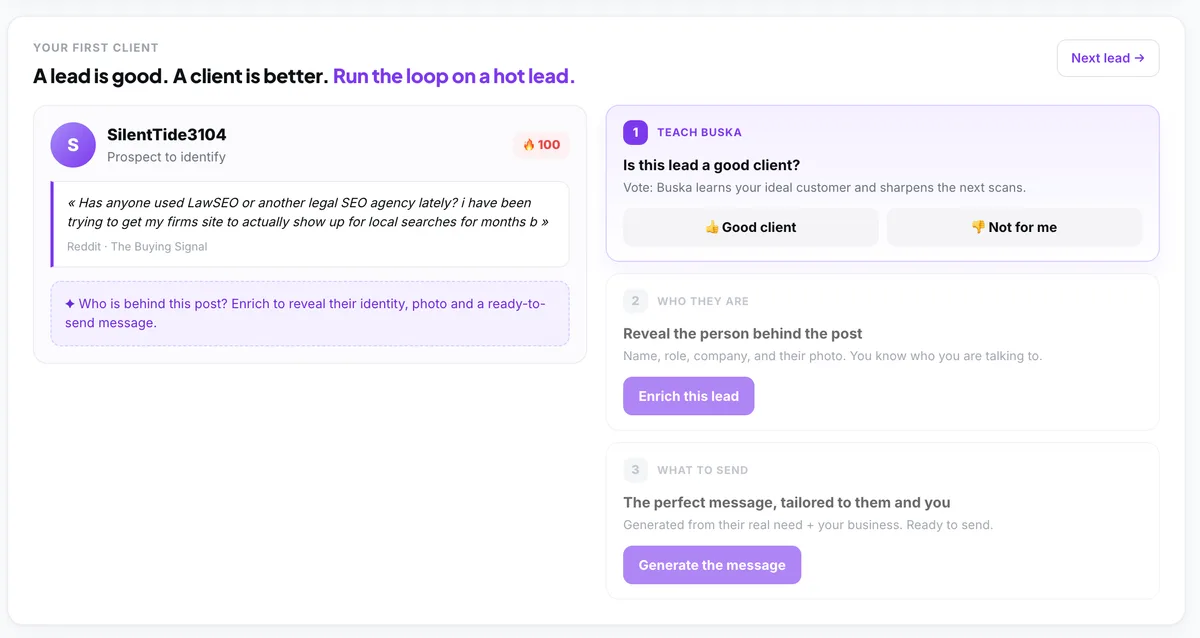
Here is what came out of it. You find a great post from someone like "u/growthguy88". With one click, Buska turns that handle into a profile card: their likely name, their role, their company, their location, and their other public profiles such as LinkedIn, GitHub, or a personal site when we can find them.
Knowing who you are talking to changes the entire first message. Instead of a generic reply, you speak to their actual role, their company, and the context they posted from. That is the difference between a message that gets ignored and one that gets a reply.
A pipeline to actually work your leads
The second request was just as loud, so we built the pipeline. Every lead now has a clear stage: to qualify, to contact, and contacted. As you give a lead a thumbs up, it moves forward on its own, so your board always reflects where things really stand, with no manual sorting and no spreadsheet.
The message you draft for a lead stays attached to it, even after you refresh the page. You never lose your work, and you pick up exactly where you left off.
How it fits together
- Buska finds a real buying signal on the platforms your buyers use.
- You qualify it with one tap, and it moves forward in your pipeline.
- You enrich the person behind it to see who they really are.
- You send a message written for them, in their language, all in one place.
How we build Buska
This is the loop we run as a team. You tell us where it hurts, we go deep on it, and we ship. Enrichment and the pipeline are two answers to what you asked for, and there is more coming from the same list. If you are on Buska today, try both and tell me what is still missing. That feedback is what we build from next.