Most social listening tools do not fail because their data is bad. They fail because nobody opens them. You buy a platform, you configure your keywords, you check the dashboard religiously for two weeks, and by week four it has quietly become another tab you never click. The mentions keep piling up, the alerts keep arriving in an inbox you have muted, and the tool you pay for every month stops changing any decision. That is the problem Eko was built to solve, and it is why we partnered with them. Eko is an AI social listening agent that works inside Slack, Microsoft Teams and Discord, so the intelligence reaches your team where they already are. Buska then handles what happens next: turning the commercial signals into qualified leads and pipeline.
What is Eko?
Eko is an AI social listening agent, not a monitoring platform. The difference is not marketing wording, it is the entire delivery model. There is no dashboard to log into, no seat to provision for every colleague, and no interface for your team to learn. You invite the agent into a Slack, Teams or Discord channel, you tell it your brand, your competitors and your keywords, and it starts working in the background.
From there it watches more than 30 platforms continuously, including X, Reddit, LinkedIn, YouTube, TikTok, Instagram, Hacker News, Product Hunt, Quora, Trustpilot, G2, app stores and the wider web of blogs and forums. Every morning it posts a short briefing in your channel. When something urgent happens, a sentiment spike or a public complaint gaining traction, it alerts the channel in under five minutes rather than waiting for the next daily digest. Eko reports that a typical workspace has around 200 conversations a day matching its filters, of which roughly 3% are surfaced as genuinely actionable.
One design decision is worth calling out, because it is the one people ask about first: the agent never publishes anything on its own. It drafts replies in your tone of voice and recommends an action, then waits. A human reads it, edits it if needed, and sends it. There is no scenario where an autonomous agent answers a customer in your name without you seeing it.
The real problem: social listening dies in the dashboard
Ask any team that has churned off a monitoring tool why they stopped, and the answer is almost never about coverage. It is about attention. Social listening produces a continuous stream of information that is only valuable if someone reads it on the day it arrives. A dashboard asks your team to remember to go and look. That works for a fortnight, then real work takes over.
The consequence is expensive in a very specific way. The value of a mention decays fast: a frustrated customer post is worth answering in the first hour and nearly worthless a week later, and a prospect asking for a recommendation has usually picked a tool within a couple of days. Discovering both in a Monday report means you find out about opportunities you can no longer act on. This is the same decay curve we described in our guide to detecting a brand crisis early.
What the Buska x Eko partnership changes
Eko and Buska solve two halves of the same problem, and they are deliberately not the same product. Eko is the listening layer that lives in your team's chat. Buska is the revenue layer: intent scoring, ICP matching, reply drafting, CRM and outreach. The partnership connects them so a commercial signal found by the agent does not stop at a notification.
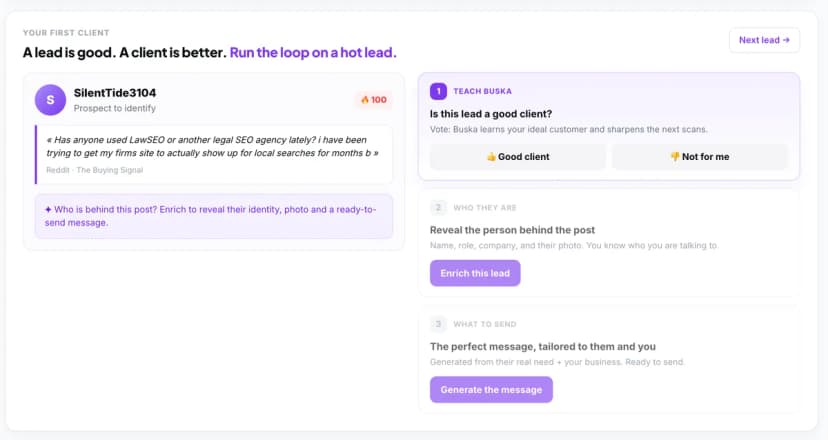
Concretely, when Eko spots a conversation that looks like a buying signal rather than a brand mention, it does not try to work the lead itself. It hands it to Buska in one click. The signal then goes through the same qualification pipeline as every other Buska lead: scored for intent, matched against your ICP, enriched, and pushed to your CRM or outreach tool.
- You invite Eko into a channel in Slack, Teams or Discord and give it your brand, competitors and keywords.
- The agent monitors 30+ platforms in the background and posts a daily briefing plus real-time alerts on anything urgent.
- It sorts what it finds into brand mentions, competitor moves, potential crises and commercial signals.
- For anything conversational, it drafts a reply in your voice and waits for a human to approve and send it.
- For anything commercial, it forwards the signal to Buska, where it is scored for intent, matched to your ICP and routed to your CRM or sequence.
| What you need | With a classic dashboard | With Eko plus Buska |
|---|---|---|
| Seeing today's mentions | Log in and remember to check | A briefing lands in your channel |
| Reacting to a crisis | Whenever someone next opens the tool | Channel alert in under 5 minutes |
| Getting the team involved | One seat per person, most never log in | Everyone in the channel already sees it |
| Answering a mention | Copy the link, switch tools, write from scratch | A draft in your tone, a human sends it |
| Turning a signal into pipeline | Manual copy-paste into the CRM | One click to Buska, then scored and routed |
| Onboarding a new colleague | Another tool to train them on | They join the channel |
Why an agent beats another dashboard
- It meets the team where they already work. Slack, Teams or Discord is already open all day. Adoption stops being a discipline problem.
- No seat maths. Eko is billed per workspace rather than per user, so the whole channel benefits without multiplying licences.
- Nothing to learn. There is no query builder and no boolean syntax to master, which is the usual reason monitoring stays with one person on the team. We wrote about that failure mode in our guide to lead generation without boolean queries.
- Triage is done before you read it. You get a short list with a recommendation, not a raw feed of every mention to sort yourself.
- The bad news arrives as fast as the good news. The same agent that surfaces praise surfaces a complaint gaining traction, which is the foundation of real brand reputation management.
Where Eko stops and Buska starts
This is the question we get most often, so it is worth being precise. The two products overlap far less than people assume, and the split is clean.
| Job to be done | Handled by | Why |
|---|---|---|
| Watching 30+ platforms for mentions | Eko | It is the listening layer, running continuously in the background |
| Telling the team what happened today | Eko | Daily briefing and urgent alerts, delivered in chat |
| Drafting a public reply in your tone | Eko | A human always reviews and sends it |
| Scoring a signal for buying intent | Buska | Intent and ICP scoring is the revenue layer |
| Enriching and qualifying a prospect | Buska | Lead qualification, not conversation monitoring |
| Pushing to CRM, sequences and outreach | Buska | Integrations with HubSpot, Lemlist, n8n, webhooks and the API |
In practice, teams that need brand visibility and crisis cover start with Eko. Teams whose primary goal is pipeline start with Buska and its 7-day free trial. Teams that want both, which is most B2B companies past their first few customers, run them together and let the one-click handoff do the joining.
What it actually looks like
Say a mid-size account posts on X that your onboarding is confusing, and the thread starts getting replies. Before, you would find it when a colleague happened to scroll past it, probably the next day, by which point the thread has its own momentum. Now the channel gets an alert within minutes, flagged as negative sentiment gaining traction, with a suggested reply already drafted in your tone. Your support lead edits two words and sends it. Total elapsed time: a few minutes, from a public complaint to a public answer.
The same morning, a different post asks which tool the author should use for exactly the problem you solve. That one is not a support issue, it is a lead. It goes to Buska, gets scored against your ICP, and lands in your sequence with the context of the original thread attached. One agent, two very different outcomes, and neither of them required anyone to open a dashboard.
Who this is for
This is for teams that have either tried social listening and quietly stopped using it, or never started because the tools looked like a second full-time job. Founders who want to know what the market says without adding a daily ritual. Support and community teams who need to catch a complaint before it compounds. Marketing teams that need reputation cover. Sales teams that want the commercial half of that stream to arrive as qualified leads rather than links. If your team lives in Slack, Teams or Discord, the setup cost is close to zero.
Want an AI agent doing your social listening inside Slack, Teams or Discord?
Discover EkoHow to get started
If you already use Buska, adding Eko gives you the listening layer in chat and a one-click path back into your existing lead pipeline. If you are starting from scratch, the fastest route is to connect Eko to a channel first, since it takes a couple of minutes and has a free tier, then plug Buska in when the commercial signals start arriving and you want them qualified. Buska offers a 7-day free trial with no credit card, and Eko can be tested without an account at all. You can compare both against the rest of the market in our roundup of the best social listening tools in 2026.
The bottom line
Social listening has had the same unsolved problem for a decade: the information is genuinely useful, and almost nobody keeps up with it, because keeping up means remembering to open something. Putting the agent inside the tool your team already has open all day removes the discipline requirement entirely. Eko covers the listening. Buska turns the commercial part into revenue. Between them there is a button, not a spreadsheet.
Turn the buying signals in those conversations into qualified pipeline
Try Buska free for 7 days