AI social listening is the use of artificial intelligence to monitor, classify, and act on public conversations across social platforms in real time. It combines natural language processing (NLP), sentiment analysis, and machine learning to turn millions of public posts into qualified intent signals automatically. In modern B2B sales, most buyers describe their problem publicly on Reddit, Twitter / X, LinkedIn, Quora, YouTube, TikTok, and 30+ other platforms long before they fill out a demo form. Teams that listen catch those signals early. Teams that do not, lose them to faster competitors. This guide breaks down the 5 ways AI transforms social listening in 2026 -- with concrete numbers, side-by-side comparisons, and real Buska product mechanics.
What is AI social listening?
AI social listening is the practice of using artificial intelligence to scan public social conversations and surface only the ones that matter. It rests on 3 core techniques. Natural language processing (NLP) reads the text. Sentiment analysis scores emotion from -1 to +1. Machine learning models trained on millions of B2B mentions detect buying intent. Together they replace the manual keyword filters of 2010-era social listening tools.
Here is the difference in one line. A traditional social listening tool answers: *who mentioned my keyword?* An AI social listening tool answers: *who is actively in market to buy what I sell, and what should I say to them?* The first question returns 100 mentions, of which 5 might be relevant. The second returns 5 mentions, of which 4 are real leads. The ratio improves from 5% useful to 80% useful.
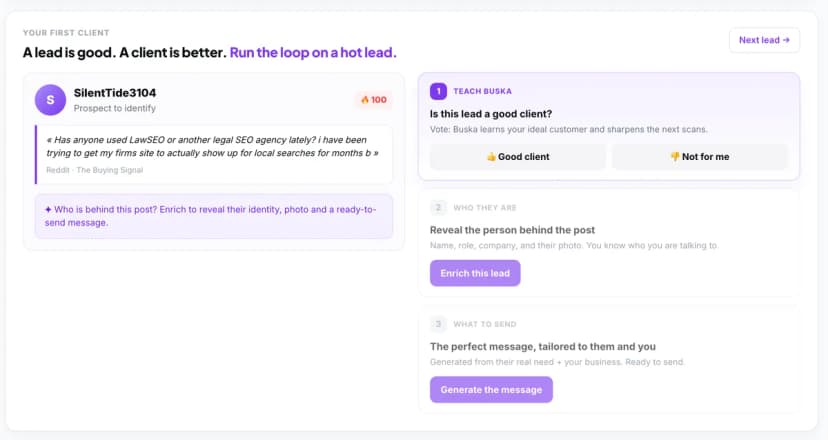
Buska is one example of an AI social listening stack. It scrapes 30+ platforms, scores every mention from 0 to 100 for buying intent, dedupes results across sources, and routes high-intent leads to Slack, HubSpot, Salesforce, Lemlist, Apollo, Clay, or any HTTP webhook. Plans start at $49 per month with a 7-day free trial.
How AI Sentiment Analysis Works
AI sentiment analysis is the automatic detection of positive, neutral, or negative tone in any piece of text. Modern models go far beyond simple polarity. They capture sarcasm, mixed sentiment, negation ("not bad"), and domain-specific nuance ("sick" is positive in gaming, negative in healthcare). Each social post is scored in under 300 milliseconds.
Why does this matter for social listening? Most public mentions of a B2B brand are neutral -- factual references, comparisons, news. The remaining minority, positive or negative, is where the action lives: champions to nurture, detractors to address, churn-risk customers to save, prospects venting about competitors to win. Without AI sentiment analysis, your team scrolls through 100% of mentions to find the 15-25% that move revenue.
Concrete use cases driven by AI sentiment analysis: catch a negative spike on Reddit within 1 hour (instead of 7 days). Surface a positive review on Quora as a testimonial candidate. Flag a neutral comment on YouTube as a research-stage prospect. Map sentiment over 30 days to detect product-market fit shifts.
AI Sentiment Analysis with Buska
Buska developed AI sentiment analysis from day one. The feature deciphers complex emotions from social chatter and gives businesses an accurate gauge of consumer sentiment. From the Buska dashboard, you see the overall sentiment around your brand or keyword, then drill into positive or negative mentions in 2 clicks.
A typical Buska user monitors 5 to 25 keywords across 30+ platforms. Every mention is scored on 3 axes: sentiment (-1 to +1), intent (0 to 100), and ICP fit (0 to 100). The dashboard shows daily sentiment trends, the top 10 positive and negative threads, and a heatmap of channels by sentiment volatility. Teams catch a brewing PR issue or a buying wave on day 1 instead of day 7.
AI Smart Filtering
Why traditional filtering fails
AI smart filtering is the process of separating relevant mentions from noise using language understanding, not just keyword matching. It is the second game-changer in modern social listening after AI sentiment analysis.
Traditional social listening tools force you to write filters with BOOLEAN logic and operators like AND, OR, NOT, NEAR/3. A typical query for a SaaS company in payments looks like `payment AND (alternative OR vs OR switch) NOT (stock OR salary OR movie)`. Get one operator wrong and you flood your dashboard with noise. Or you miss the prospect who described his pain in 1 sentence that broke your boolean. Boolean filtering takes 2 to 4 hours to set up per keyword. AI smart filtering takes 5 minutes.
How AI smart filtering works
AI smart filtering does all the work for you. You share a few elements of context around your brand. For example: keyword: apple, context: software company. AI smart filtering then keeps mentions relevant to that context and quietly sets aside mentions about the fruit, the recipe, or the music label.
Under the hood, Buska embeds each mention as a 1,536-dimension vector using OpenAI's text-embedding-3-small model. It compares that vector to your ideal customer profile (ICP) embedding using cosine similarity. Mentions above a calibrated threshold are kept. The rest are dropped. The result is a 90% reduction in noise without writing a single boolean operator.
- Sentiment scoring at the mention level (positive, neutral, negative, -1 to +1)
- Intent detection to flag buying signals on a 0 to 100 scale
- Smart noise filtering that learns from your saved leads (90% noise cut)
- Predictive analytics for trends and competitor activity (rolling 30 days)
- Personalized routing to Slack, HubSpot, Lemlist, and 15+ other tools
AI social listening vs traditional tools
How does AI social listening compare to legacy social listening platforms? The differences show up in 6 places: setup time, noise rate, sentiment accuracy, intent detection, platform coverage, and price. Here is the side-by-side.
| Capability | Traditional social listening | AI social listening (Buska) |
|---|---|---|
| Setup time per keyword | 2 to 4 hours of boolean filters | 5 minutes from URL paste |
| Noise rate | 60 to 80% irrelevant mentions | Around 10% (90% reduction) |
| Sentiment detection | Keyword polarity only | NLP-based, sarcasm-aware |
| Intent detection | Manual review by an SDR | Automatic 0 to 100 score |
| Platform coverage | 10 to 12 platforms | 30+ platforms |
| Starting price | $200 to $1,000 per month | $49 per month, 7-day trial |
The Future of Social Listening with AI
AI's role in social listening is set to grow over the next 3 years. With advancements in predictive analytics, AI will analyze past and present social conversations and forecast trends before they hit mainstream awareness. Models will predict churn risk 30 to 60 days in advance based on sentiment drift patterns. AI will also draft replies, suggest follow-ups, and grade the quality of every outbound message.
The integration of AI in social listening strategies promises a more dynamic, responsive, and personalized interaction with the digital audience. Early adopters report multiple-x more pipeline sourced from social mentions in 2025. By 2027, AI-augmented social listening will be a default expectation for any B2B GTM team -- not a competitive edge anymore.
Conclusion
AI's role in social listening is transformative. It expands every capability of social listening for businesses: sentiment analysis, smart filtering, predictive analytics, and intent-based routing. With AI-powered tools like Buska, organizations navigate social media in 5 minutes per day, making informed decisions that drive engagement and growth.
Buska monitors 30+ platforms, scores every mention from 0 to 100, and integrates with Slack, HubSpot, Salesforce, Lemlist, Apollo, Clay, and 15+ other tools -- starting at $49 per month with a 7-day free trial. As AI continues to evolve, its integration into social listening strategies will become not just advantageous but essential for any business aiming to stay ahead in the digital age.
Experience AI-powered social listening with Buska
Start free trial